
Governance Overview

University of Lincoln Academy Trust (UoLAT) is an educational charity regulated by the Secretary of State for Education and governed by its Articles of Association and Master funding Agreements which you can find on this website.

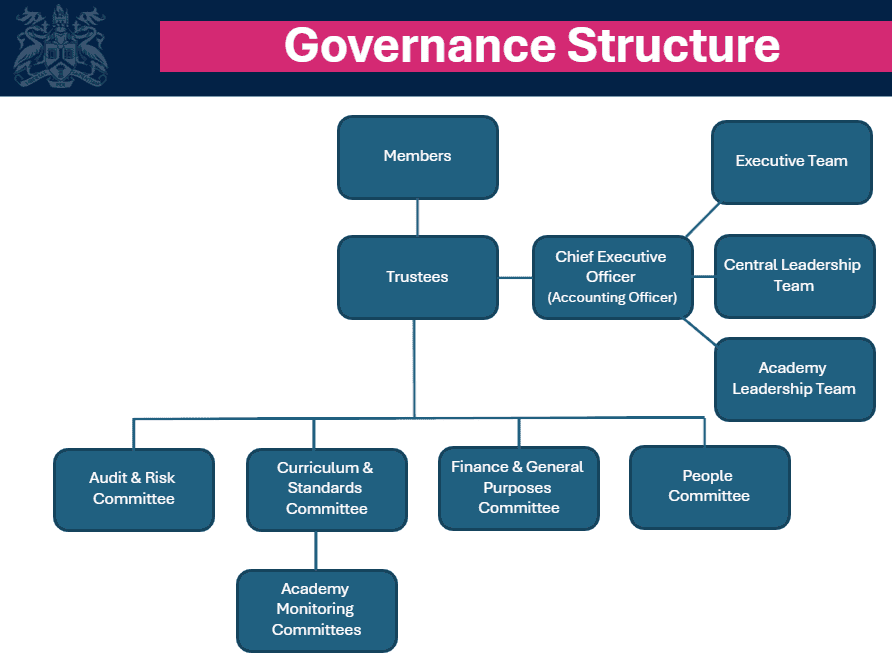
Effective governance in our Trust is supported by the following:

Members:

These are guardians of the constitution. Members have the power to amend the Articles of Association, appoint Trustees and fellow Members. ​They hold Trustees to account, should there be concerns over its administration, governance and financial controls.

Trustees:     

Trustees are accountable for educational standards and financial conduct across the Trust. They may take decisions that are set out by Company Law and the Regulator (Secretary of State for Education (Department for Education)). As such, on an annual basis, a Scheme of Delegated Authority (SoDA) is agreed which sets out those decisions and who will be responsible for taking them. ​In addition to the SoDA, a Policy Schedule is agreed, which delegates responsibility for the review, approval and implementation of all policies. These are delegated to committees and selected post holders. ​

Trust Board Committees: 

These groups have been established to discharge certain functions that have been delegated to them by the Board of Trustees. Each Committee has its own terms of reference, which can be found later in this document. They are chaired by and consist of trustees who, through their own work experience, can provide an expert lens on specific areas allowing the trusts corporate governance to make informed decision. How they do this is detailed in our Governance and Scheme of Delegation document.

Academy Monitoring Committees:

Trustees have established an Academy Monitoring Committee for each of its academies. Those involved in our local governance provide a strategic lens on local academy performance, offer challenge and support to the academy and ultimately provide assurance to the board. They monitor the work of academy leadership by evaluating pupil progress and attainment, alignment with the Trust’s vision and values, continual review of processes and procedures.

The governance structure is underpinned by the Articles of Association and details set out in the Academy monitoring Committee Scheme of Delegation which shall be reviewed at least annually.

Financial governance, must as a foundation, be compliant with the principles and regulations set out in the Academies Financial Handbook and the Funding Agreement.

In practice our Trustees, who are volunteers, delegate almost all aspects of the day-to-day operation of the Trust to the Chief Executive Officer (Stuart Anderson) and the Executive Leadership Team, and the day-to-day leadership of each academy is delegated, of course, to the Principal.

Board Diversity:

Due to the number of Trustees, we do not publish our diversity data online as individuals could be identified and we have a legal obligation to protect their personal data.

The conduct of the Trust’s business at all levels is critical to the reputation of the Trust and its sponsors, The University of Lincoln.  Members, Trustees, Academy Monitoring Committees and executive staff must declare any real or perceived interests that arise as part of their work. If they have any doubts they must consult the CEO/Accounting Officer for advice before taking part in any discussion on a potential related matter. The golden rule is one of declaring an interest if in doubt. The Trust expects everyone to not only adhere to Nolan’s Principles of Public Life, avoiding real but also perceived conflicts of interest with any connected party relationships.

The Department for Education (DfE) launched a new voluntary code for Academy Trust Governance; the Academy Trust Governance Code 2024.

The Code was developed by a steering group on behalf of the academy trust sector, which included; National Governance Association, Chartered Governance Institute, Confederation of School Trusts and Stone King LLP Solicitors.

Keen to show their commitment to ensuring effective governance, Trustees agreed to adopt the new Code in May 2024.

The code consists of a ‘Fundamental’ Principle, along with seven further principles.

Fundamental Principle

Committed to the Academy Trust’s charitable Objects and are determined to deliver the Academy Trust’s purpose and aims; Understand their roles and legal responsibilities, and have read and understood the Articles of Association, the Academy Trust’s governance documents, DfE guidance and, in the context of Voluntary Academies, guidance from the Academy’s relevant Foundation; and Committed to effective governance and contributing to the Academy Trust’s continued improvement.

 Seven Principles

Delivering the academy trust charitable objects

The Academy Trust’s Articles of Association sets out the Academy Trust’s charitable Objects and how those must be fulfilled. The Board is clear about its aims and ensures that they are being delivered effectively and sustainably.

Leadership

The Academy Trust is led by an effective Board that provides strategic governance in line with the aims and values of the Academy Trust and engages effectively with its Members.

Integrity

The Board acts with integrity, adopting values and creating a culture which helps achieve the Academy Trust’s charitable Objects. The Board is aware of the importance of public confidence and trust in Academy Trusts and their Schools, and the Board undertakes its duties accordingly.

Decision making, risk and control

The Board ensures that its decision-making processes are evidence informed, rigorous and timely and that effective delegation, control, risk assessment and management systems are set up and monitored. There is effective reporting at all levels of Academy Trust governance to ensure decisions are taken at the correct level in accordance with the Articles of Association and Scheme of Delegation.

Board effectiveness

The Board works as an effective team, using the appropriate balance of knowledge, skills, experience, and backgrounds to make informed decisions.

Equality, diversity and inclusion

In ensuring the effective achievement of the Academy Trust’s charitable Objects, the Board has a clear, agreed and effective approach to advancing equality, diversity and inclusion throughout the Academy Trust.

Openness and accountability

The Board leads the Academy Trust in being transparent and accountable. The Academy Trust is open in its work, unless there is good reason for it not to be

Contact Us

Address
University of Lincoln Academy Trust
Park Road
Holbeach
Spalding
Lincolnshire
PE12 7PU